Free guide by Zarif Kesar
Real or fake? Your saffron can tell you.
Saffron is one of the most faked foods in the world. These simple home checks expose dyed silk, paper and safflower in minutes.
01 The water test
The fastest way to catch a fake
Drop 3–4 threads into a glass of warm water. Press play and watch what happens over 15 minutes.
- 1Warm water, not boiling
- 2Add 3–4 threads, don’t stir
- 3Watch the colour and the thread
02 Look closely
Switch between real and fake
Spread a few threads on white paper and look at the shape, the colour and the ends.
- 1Trumpet-shaped tipEach real stigma flares open like a tiny funnel at the top.
- 2Deep, natural redRich crimson body, with slight differences between threads.
- 3Paler, yellowish baseWhere the thread joined the flower. A little yellow is normal.
- 1Flat, cut endsNo flared tip. Strands look sliced or uniform.
- 2Too bright, too evenThe same bright red from end to end suggests dye, silk or paper.
- 3Yellow and white bitsLots of these mean cheaper flower parts were added for weight.
03 Use your senses
Five checks, one clear answer
No single test is proof. Pick a sense to see what real and fake look, smell and feel like.
Check 1 of 5
Look
Spread threads on white paper.
Trumpet tip, deep red, natural variation in length.
Flat strands, all one size, unnaturally bright.
Check 2 of 5
Smell
Open the jar and breathe in.
Sweet, honey-like and floral, strong even from a few threads.
No smell at all, or a chemical, dusty smell.
Check 3 of 5
Water
Drop 3–4 threads in warm water.
Slow golden-yellow colour over 10–15 minutes, and the thread stays red.
Red colour floods out in seconds, and the strand turns pale.
Check 4 of 5
Taste
Place one thread on your tongue.
Slightly bitter, even though it smells sweet.
Sweet, or no taste at all.
Check 5 of 5
Rub
Soak a thread, then rub it between your fingers.
Stains fingers yellow-orange and stays whole.
Leaves a red stain or breaks into paste.
04 Myth or fact?
Can you spot the myths?
Tap your answer on each card. 0 / 4 correct so far.
“The redder the saffron, the better it is.”
“Real saffron releases its colour slowly in water.”
“Good saffron should taste sweet.”
“A little yellow at the base of a thread is normal.”
05 Check yours
Test your own saffron in 6 questions
Keep your saffron, a glass of warm water and a white paper handy. Answer honestly. You can say “Not sure”.
- Takes about 15 minutes
- Instant, private result
- Works for any brand
Do the threads flare into a small trumpet at one end?
In warm water, does the colour come out slowly as golden-yellow?
Does it smell sweet and honey-like?
Does it taste slightly bitter rather than sweet?
After soaking, does a thread stain your fingers yellow and stay whole?
Is it dry and brittle, not oily or sticky?
A guide, not a lab test. Home checks catch common fakes but cannot confirm grade or purity. Only an ISO 3632 laboratory test can do that.
Our promise
Saffron you can check for yourself
Origin on every jar
Kashmiri is from Kashmir. Signature is a selected imported grade, and we say so.
Clear jars
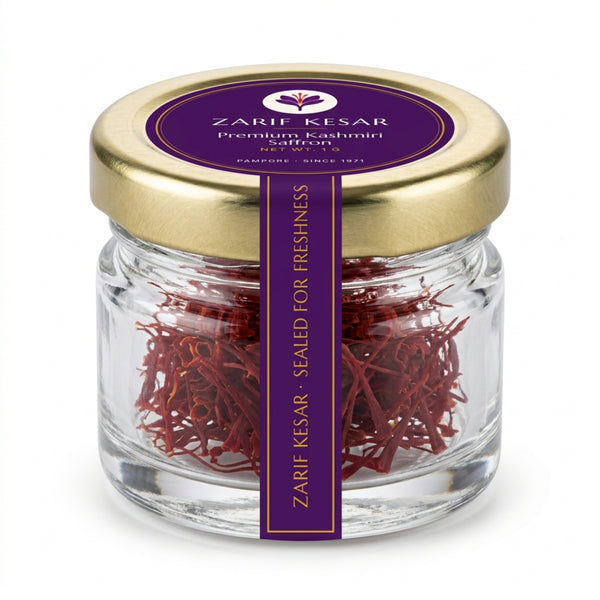
Whole threads you can see and inspect before you open them.
Test us
Not as described? Tell us within 48 hours of delivery.
A real business
Pampore since 1971. GSTIN 01CDMPT1374B2ZS.